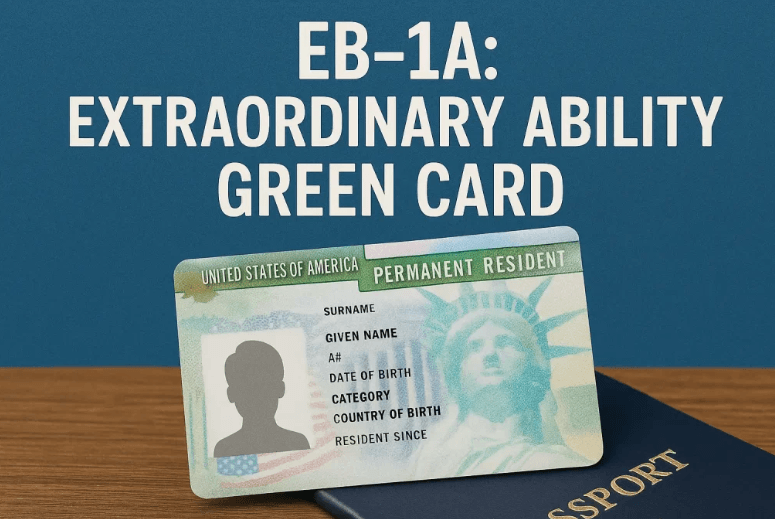
The EB-1A Green Card category is one of the most prestigious and misunderstood immigration pathways in the United States. Many professionals assume that the EB-1A is reserved only for Nobel Prize winners or world-famous researchers. In reality, USCIS evaluates whether an applicant has demonstrated sustained national or international acclaim and belongs among the small percentage at the top of their field.
However, one of the biggest mistakes applicants make is approaching the EB-1A as a “checklist game.” What they miss is that strategic optimization matters far more than randomly collecting achievements. The strongest EB-1A profiles are carefully aligned with the right criteria based on the applicant’s background and long-term positioning.
Understand that not all criteria are equal for every profession
USCIS provides ten regulatory criteria, and applicants generally need to satisfy at least three. This includes criteria like paper publications, judging, media, high remuneration and more.
However, not every criterion is equally practical or persuasive for every professional.
For example:
- A software engineer may have strong evidence for judging, original contributions, a critical role, and a high salary.
- A researcher may naturally fit publications, citations, peer review, and scholarly authorship.
- A business executive may be stronger in leadership roles, media recognition, and industry awards.
- An artist may rely more on exhibitions, media coverage, commercial success, and awards.
Hence, the essential key is to identify the criteria that fit your organic career trajectory instead of trying to force artificial evidence into multiple weak categories. Below are some ways you can strategically pick and choose from the criteria for your EB-1A profile.
Focus on building depth instead of chasing quantity
One of the most common reasons EB-1A petitions fail is that applicants attempt to satisfy many criteria superficially rather than develop strong evidence in a few meaningful areas. USCIS officers increasingly examine the quality and credibility of evidence, not just the number of exhibits submitted.
For example, having:
- two strong national awards,
- meaningful media coverage,
- documented judging experience,
- and measurable original contributions
could usually be more persuasive than weak evidence spread across seven categories.
Strategic optimization means selecting criteria where your achievements can demonstrate measurable impact and recognition.
Build around “Original Contributions” whenever possible
Among all EB-1A criteria, “original contributions of major significance” is often one of the most powerful. USCIS wants evidence that your work influenced your industry, research area, or broader professional ecosystem.
This criterion becomes much stronger when supported by:
- patents,
- implementation metrics,
- citations,
- revenue impact,
- adoption by other organizations,
- industry references,
- or recommendation letters from independent experts.
Instead of merely saying you “worked on important projects,” demonstrate how your work changed outcomes.
For example:
- Did your innovation reduce costs significantly?
- Did your research influence other scholars?
- Did your product scale to millions of users?
- Did your strategy improve organizational performance measurably?
The more quantifiable the impact, the stronger your profile will be.
Develop a long-term judging profile
The judging criterion is often underestimated. USCIS considers judging as evidence that others in the field recognize your expertise.
Professionals can strategically strengthen this area by:
- reviewing conference papers,
- judging hackathons,
- evaluating startup competitions,
- reviewing journal submissions,
- participating in award panels,
- or mentoring recognized industry programs.
Importantly, the judging opportunities should appear legitimate and field-relevant. Random or low-quality judging activities may not carry significant weight.
Prioritize credible media recognition
Media coverage is another highly valuable criterion when properly executed. However, USCIS distinguishes between genuine recognition and self-promotional content.
Strong media evidence typically includes:
- interviews,
- industry features,
- articles discussing your work,
- podcast appearances,
- conference highlights,
- or coverage by recognized professional publications.
The focus should be on third-party validation. Articles written by you about yourself generally do not qualify under this criterion.
A strategic media plan over time can dramatically improve the overall strength of an EB-1A profile.
Create a cohesive narrative
Perhaps the most overlooked aspect of EB-1A optimization is storytelling.
USCIS officers are not domain experts in every industry. Your petition must clearly explain:
- Why your work matters,
- How your achievements compare to those of your peers,
- Why your recognition is significant,
- And how your career demonstrates sustained acclaim.
Many applicants technically satisfy three criteria but still struggle because the evidence lacks a coherent narrative.
Your profile should answer one central question:
“Why is this individual among the top professionals in the field?”
Every document, letter of recommendation, media article, and achievement should work together to reinforce that answer.
Avoid artificial profile building
In recent years, USCIS scrutiny has increased substantially, especially for low-quality checklist profiles. The EB1A experts frequently note that officers are becoming more sceptical of evidence created solely for immigration purposes. Instead of a checklist profile, you should always aim for an organic profile.
This means strategic optimization should focus on authentic career growth rather than shortcut tactics.
Organic accomplishments almost always carry more credibility than rushed profile-building activities.
In place of conclusion
Optimizing an EB-1A profile is not about collecting random credentials. It is about aligning your career achievements strategically with the criteria that best reflect your professional excellence. You should not aim to game the criteria, but use the criteria strategically to reflect your real professional achievements. This is exactly why you can consider green card consulting. A thorough consultancy service will mentor you to strategically select all the criteria so that your achievements speak volumes.