Bigger Clusters Usually Mean More Complexity
For many years, expanding a data center followed a familiar pattern.
When traffic increased, operators added another aggregation layer. When server counts grew, additional switches were introduced. As infrastructure expanded, the network gradually accumulated more tiers, more uplinks, and more interconnection points.
This approach worked reasonably well when applications generated predictable traffic and growth happened gradually.
Modern AI infrastructure has changed those assumptions.
Today’s training clusters can contain thousands of GPUs exchanging information continuously. Storage platforms move enormous datasets between compute resources. Distributed workloads span multiple buildings and data halls.
As these environments scale, network complexity grows rapidly.
The challenge is no longer simply providing bandwidth.
The challenge is preventing the architecture itself from becoming a bottleneck.
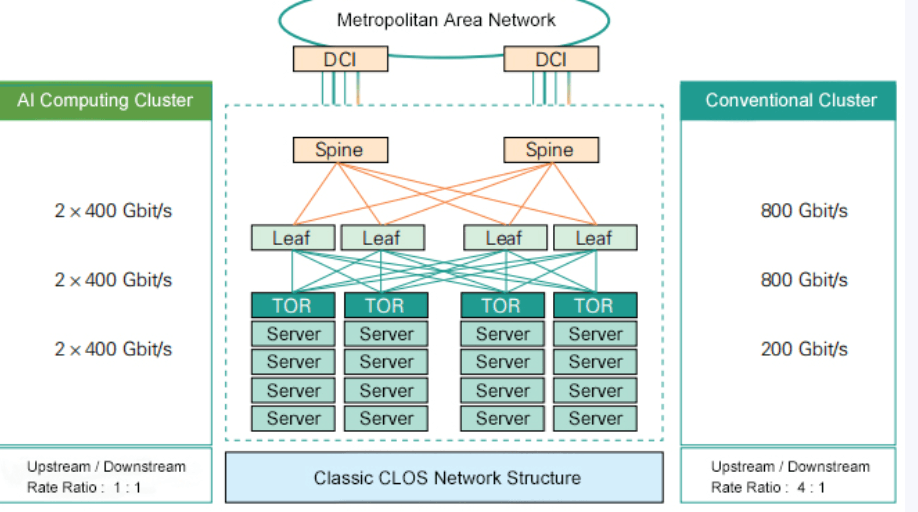
This is one reason why many organizations are actively pursuing flatter network designs.
Why Network Layers Create Hidden Costs
Every layer inside a network serves a purpose.
Aggregation switches help consolidate traffic. Core layers provide centralized connectivity. Additional routing domains improve scalability.
But each layer also introduces tradeoffs.
Traffic must pass through more devices. Additional management points are created. More hardware consumes more power. Troubleshooting becomes more complicated because packets travel through a larger number of systems before reaching their destination.
Individually, these effects may seem minor.
At AI scale, however, they become increasingly significant.
A network supporting thousands of accelerators benefits from simplicity. Fewer devices often mean fewer failure points, more predictable traffic behavior, and easier operational management.
The industry’s growing interest in flatter architectures reflects this reality.
Why Higher-Speed Links Make Simplification Possible
Historically, networks expanded because lower-speed links could not handle growing demand.
If a switch reached capacity, operators added more devices. If traffic increased, additional aggregation layers helped distribute the load.
The arrival of 400G and 800G networking changes that equation.
A single optical link can now carry traffic volumes that previously required multiple connections and additional switching resources.
This makes it possible to rethink network topology.
Instead of building larger networks through additional layers, operators can increasingly rely on higher-capacity links to connect resources directly.
The NVIDIA/Mellanox MMS4X50-NM compatible 800G 2×FR4 OSFP transceiver is designed for exactly this type of environment.
Its combination of high bandwidth and moderate-distance reach helps connect major infrastructure domains without requiring unnecessary intermediary devices.
The Importance of the 2km Distance Window
Many discussions around optical networking focus on maximum transmission distance.
In practice, what matters more is whether the reach matches the deployment.
The 2km capability of FR4 technology sits in a particularly useful position.
It extends far beyond traditional intra-rack and intra-row connectivity while remaining simple enough to operate within standard data center environments.
Most campus-style deployments, multi-building AI clusters, and distributed computing facilities fall comfortably within this range.
Because of that, organizations can often connect separate infrastructure zones directly rather than introducing additional switching layers between them.
The result is a cleaner and more efficient architecture.
Sometimes reducing network complexity is more valuable than extending network reach.
Why Duplex LC Connectivity Supports Simpler Designs
Another factor contributing to flatter architectures is physical infrastructure simplicity.
Large-scale MPO deployments certainly offer density advantages, but they can also increase cabling complexity as networks grow.
The MMS4X50-NM compatible module uses duplex LC connectivity combined with wavelength multiplexing technology.
This approach allows 800G traffic to travel over just a pair of single-mode fibers.
For operators managing large campus environments, this creates several practical advantages.
Fiber management becomes easier. Existing infrastructure can often be reused. Expansion projects require fewer physical modifications.
Most importantly, high-capacity connectivity becomes accessible without introducing additional cabling complexity.
Physical simplicity often supports architectural simplicity.
Connecting Buildings Without Creating New Layers
As AI deployments continue expanding, organizations frequently encounter a common challenge.
Additional compute resources are deployed in neighboring buildings because existing facilities run out of power, cooling capacity, or floor space.
The question then becomes how to connect these environments efficiently.
One option is to build dedicated transport layers between facilities.
Another option is to extend the primary network fabric directly.
The second approach has become increasingly attractive as optical technology evolves.
An 800G FR4 link can provide sufficient bandwidth to connect major infrastructure domains without introducing an entirely separate networking layer.
This allows organizations to treat multiple facilities as part of a unified environment rather than a collection of isolated systems.
Twin-Port Architecture Helps Future-Proof Growth
One reason network planners appreciate FR4-based solutions is flexibility.
Traffic patterns rarely remain static.
An inter-building connection deployed today may support entirely different workloads two years from now. Capacity requirements may shift. Infrastructure priorities may change.
The 2×FR4 twin-port architecture provides options.
Operators can deploy the module in different configurations depending on current requirements while preserving flexibility for future adjustments.
This adaptability reduces the risk of infrastructure becoming locked into a single design strategy.
When building large-scale networks, flexibility is often as important as raw performance.
Air-Cooled Infrastructure Isn’t Going Away Anytime Soon
Much of the industry discussion surrounding AI focuses on liquid cooling.
While liquid-cooled compute environments are expanding rapidly, the networking layer remains heavily dependent on air-cooled systems.
Switch platforms such as Quantum-2 InfiniBand and Spectrum-4 Ethernet continue to rely on efficient airflow management to maintain stable operation.
The finned-top design used by the MMS4X50-NM compatible module supports this requirement by improving thermal dissipation inside high-density switch environments.
Reliable thermal performance becomes increasingly important as port speeds rise and aggregate bandwidth reaches unprecedented levels.
Even the most advanced network architecture depends on stable physical operation.
Building Networks That Feel Smaller Than They Are
Perhaps the most interesting trend in modern infrastructure is that some of the largest networks are designed to appear simple.
Operators are moving away from architectures that rely on numerous intermediate layers and toward designs that emphasize direct connectivity and operational clarity.
High-speed optical technologies play a major role in enabling that shift.
The MMS4X50-NM compatible 800G 2×FR4 transceiver helps organizations connect large infrastructure domains while avoiding some of the complexity traditionally associated with large-scale growth.
In many ways, the future of networking may involve making massive environments feel operationally smaller.
Conclusion
The NVIDIA/Mellanox MMS4X50-NM compatible 800G 2×FR4 OSFP optical transceiver is more than a high-bandwidth connectivity solution. It supports a broader movement toward flatter, more streamlined network architectures. By combining 800G performance, duplex LC connectivity, 2km single-mode reach, and a flexible twin-port design, it enables organizations to connect distributed infrastructure directly while reducing dependency on additional network layers. As AI clusters and large-scale data centers continue expanding, technologies that simplify architecture while maintaining performance are likely to play an increasingly important role in future network design.